 English
 Español
Plural Selves – and our community of selves
Cris, Peluchita and Zora – of the community of Alana Queer @alanaqueer@fe.disroot.org
(Translation from the original, which was written in Spanish)
Peluchita: Zora, what do you think about us writing about our community? And about plural selves? I think you and I are well placed to write about this topic. You, as the first of our selves with whom we connected, and me as our observing and reflective self.
Zora: I think that’s a good idea, Peluchita. It could be really interesting. Both for us, to explore our history and our community a bit, but also for other people who want to learn more about plural selves.
Peluchita: What do you think about including Cris as well? Cris knows a lot about the subject, and is our activist.
Zora: Yes, you’re right. But it makes me feel a bit uncomfortable. Cris often ignores me and my needs, and also Alex and La Rigby, when they takes centre stage; they become our emphasised self at that moment. And that’s something I don’t like.
Peluchita: Phew, I know, Zora. Let’s look after ourselves and set boundaries for Cris, so they learn not to forget about our well-being. You mustn’t forget either that Cris and their activism have, in a way, saved our lives – they’ve allowed us to escape our parents’ toxic home. But, yes, that doesn’t justify them forgetting about us.
Zora: OK, Peluchita. I trust you and your powers of observation to set boundaries for Cris when necessary. And if they don't respect those boundaries, we'll have to write the article without them.
Peluchita: All right, Zora. Let's give it a go.
Introduction: plural selves
In this article, we want to explore the topic of pluralities – or plural selves, subpersonalities, parts, or whatever term you prefer to use. In our Western culture, the idea or ideal of a single self generally prevails, and having more than one self is often classified as a disorder – schizophrenia or dissociative identity disorder. In other cultures, the idea of a single self seems absurd, and the plurality of selves is the most ‘normal’ thing.
James Fadiman and Jordan Gruber write: “In the early days of psychology, the only real controversy was between two groups: one, made up of scientists and philosophers who believed that every human being possessed multiple selves, and the other, comprising leading clinicians—who were working on the development of the first theories of mental illness—who believed that different selves only appeared in their patient population.”1
According to the psychologist John Rowan, subpersonalities – his term for multiple selves – “are, for the most part, quite normal, [but] can sometimes become a problem, and this tends to happen above all when we categorically deny that we have anything of the sort. Repression, splitting and denial often cause problems. Sometimes subpersonalities need to be regarded as distinct characters, but in reality they are constantly evolving and can split into two, merge into one, appear or disappear.”2
Meg-John Barker wrote in an article that many queer thinkers “... argue that the idea that a person has a fixed and stable identity is a recent invention linked to urbanisation and capitalism (...). Therefore, the very idea that people are plural rather than singular, and ever-changing and fluid rather than fixed, could be seen as a particularly queer way of understanding the self. From a queer perspective, singularity and fixity would be the narratives of the self that we might question as problematic, rooted as they are in a broader, pathological cultural worldview that demands we categorise people as distinct individual units in order to justify valuing some lives and bodies more than others.
Plurality is also linked to gender and sexuality in more explicit ways. Firstly, there are overlaps between plural experience and trans/non-binary experience. Many plural people (though not all) have selves of different genders and, often, of different ages as well.”3
In another post, they say: “In fact, one could argue, as some sociologists have done, that the concept of a singular self is an invention of neoliberal capitalism. We are all pressured to tell stories about ourselves as if we were consistent and coherent, when in reality we are all complex and contradictory. One could even say that experiencing oneself as something entirely singular is ‘madness’, and that trying to present oneself in that way is harmful to oneself. Many indigenous cultures understand being as something that encompasses plurality and would view the idea of a singular self as strange or improbable.”4
Nevertheless, in our Western culture, the idea of a single self remains dominant. To speak openly about the plurality of selves means, at best, running the risk of not being understood; at worst, facing a diagnosis of a mental disorder. It seems that the prominent clinicians discussed by Fadiman and Gruber have won the battle. Although I feel that the landscape is gradually changing.
Plural systems
In his book On Multiple Selves, David Lester summarises a multitude of models and explanations of plural selves, parts, archetypes, subpersonalities – or whatever one wishes to call the fact that we all – or the vast majority of us – are multiple5. There isn’t enough space here, nor do I feel qualified, to provide a similar summary of models of pluralism, as I do not consider myself an expert on the subject. For anyone interested in the book, I recommend looking for it in Anna’s Archive6 and to download it, as it is quite expensive.
Richard Schwartz says that Carl Jung, with his system of archetypes, also recognised these pluralities. He says: “Carl Jung (1962) also recognised the existence of a multiplicity within himself and within his patients, and, through a process called active imagination, he was able to gain access to that inner world. Of the inhabitants he encountered there, he observed the following: ‘There are things in the psyche that I have not produced, but which have produced themselves and have a life of their own… they possess a certain degree of autonomy, a distinct identity of their own. The autonomy they possess presents a situation with which one finds it difficult to come to terms…’”7.
Perhaps the best-known model today is Richard Schwartz’s ‘internal family systems’ model. Personally, it is not the model that appeals to me the most, and I could never bring myself to call my internal community a ‘family’, as the term ‘family’, for me, is synonymous with mistreatment, abuse and violence8. But beyond the term ‘family’, there are other aspects of this model that I’m not convinced by, or that I don’t experience in that way.
Richard Schwartz talks about how we all have parts, and he also insists that there are no ‘bad’ parts. According to Schwartz, all our parts, after all, want to protect us, although they may do so in ways that are not particularly healthy or helpful. Schwartz categorises these parts into three main types: exiled parts, executive parts, and firefighter parts.
The exiled parts are the youngest, most vulnerable parts that have suffered trauma and are isolated from the rest of the system for their own protection and that of the system. The exiled parts are the bearers of the memories, emotions, sensations and impulses linked to the events, and are stuck in the past.
The executive parts manage the person’s daily life. These parts attempt to keep the exiled parts in exile by controlling events or relationships, by being perfect and accommodating, by looking after others, and by instilling a fear of risk in people through criticism, apathy, worry, etc.
Firefighters are parts that react to the activation of exiled parts in an effort to suppress their feelings or dissociate the person from them. Common activities of firefighters include: alcohol or drug use, self-harm (cutting), compulsive eating, compulsive sex, suicidal ideation and anger. Firefighters have the same objectives as the executive parts, which are to keep the exiled parts at bay, although they follow different, more impulsive strategies.9.
Beyond the parts, according to Schwartz, lies the Self, which is defined as the seat of consciousness—a level of being distinct from that of the parts. The Self, unlike the parts, is invisible because it is the observing ‘I’. According to the internal family systems model, the Self possesses qualities such as compassion, trust, curiosity and perspective—qualities essential to good leadership. According to this model, each of us has a Self, which may be obscured by the extremes of the parts.
The idea behind working with the parts is to bring the exiled parts out of their exile, tend to their wounds and heal them, so that they can play a healthier role within the system. To achieve this, the executive and firefighter parts need to relax, allowing us to access the exiled parts. The aim is ultimately to end up with a more balanced system of parts, with fewer extremes, and to be able to access the Self more fully and completely.
Zora: So, who is our Self? Do we have a Self?
Cris: I don’t think we have a Self. Or, if we’re talking about the ‘I’ that observes, that’s you, Peluchita.
Peluchita: Yes, I observe. I give you feedback, or, above all, I give feedback to Alana when we have our hot chocolate in the evening. But that doesn’t mean I’m the Self. That would be absurd.
Cris: Yes, that would be absurd. You’re right. I don’t think we fit very well into the three categories of parts either. I suppose I’d be an executive part. But I don’t think so. Or, it depends very much on the context. In activism, together with Ginger, perhaps so, but in other aspects of our lives, no.
Zora: Yes, but you have a tendency to shut me and Alex down when you take charge.
Cris: I’m sorry, Zora. It’s something I still need to learn – not to cover you up. I used to cover you up to protect you, 45 years ago now, but I realise that’s no longer necessary.
Zora: No, it’s not necessary anymore. But thank you, Cris. I don’t know how I fit into the categories either. I’ve clearly been an exiled figure – just like Alex or La Rigby, or even Alana. But now I also protect Alex and La Rigby sometimes, though I don’t send them into exile, I think. And Alana looks after almost all of us.
Peluchita: Yes, Zora, you try to look after them, to protect them. You often do this out of anger, and not always in the best way. But I agree with you – you don’t stop other aspects of ourselves from reaching Alex or La Rigby to look after them too and tend to their wounds. And, Zora, I try to look after Alana. Because it’s important to look after those who look after others, too.
Cris: So, we conclude that we don’t have a ‘Self’, and that we don’t fit into those categories. What’s more, the concept of the ‘Self’ introduces a hierarchy, which isn’t something we experience amongst ourselves either. Perhaps there’s another model that better explains how we experience our community?
Among models of pluralities, there is a debate as to whether or not a hierarchy of selves, a coordinating figure, or a benevolent dictator is necessary. Many people cannot imagine that a plural system could function without hierarchy. Perhaps this reflects the values of the cis-heteropatriarchal, capitalist and colonial system in which we live, rather than the reality of pluralities. Could a plural system of selves (or parts) function in an anarchist manner within a hierarchical and violent social and political system? I believe it could.
The model that works best for us is Meg-John Barker’s model, which cannot (yet) be found in academic publications, but in texts and fanzines10 on their blog. I would say it is an emerging model that is still undergoing changes – and perhaps it will never be a ‘fixed’ model. The model is based more on Meg-John Barker’s experience with their own community of selves.
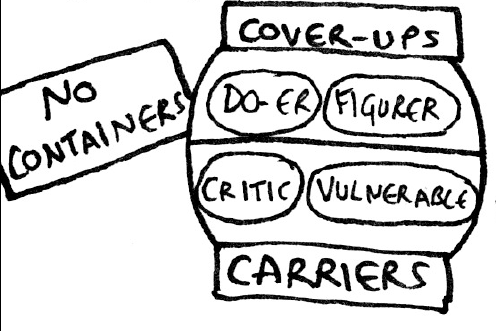
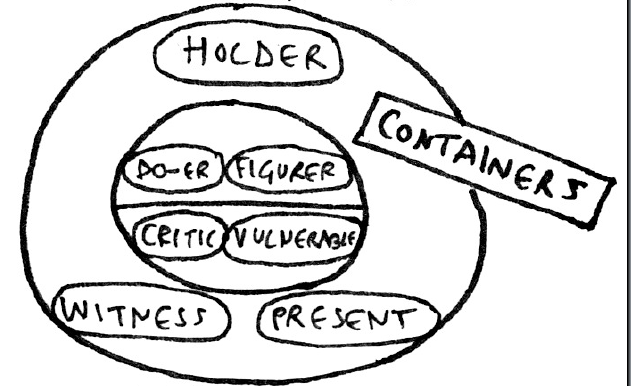
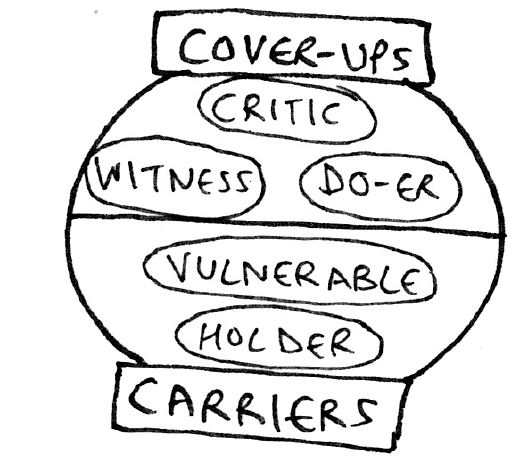
In Meg-John Barker’s model, there are also three main categories of selves:
The carriers are the renegade selves that carried our traumatic feelings, perhaps similar to the exiled parts. There are mainly two types of carriers: the critics and the vulnerable ones. Although both could also fall into another category.
The cover-ups are the emphasised selves that enabled us to survive in the world. They are the selves we present to the outside world. The main types of cover-ups are the Doers and the Problem-Solvers.
And the containers are the selves with the capacity to hold and listen to the other selves in a certain way. The main types of Containers are the Holding Ones, the Witnesses, and the Present Ones11.
These different categories and types of ‘selves’ can be configured in various ways. There may be more than one ‘self’ within each category. Sometimes there is no ‘container’ at all, or we are unaware of its existence.
|
|
|
|
|
|
|
Some configurations of the different types of ‘selves’, according to Meg-John Barker12 |
|
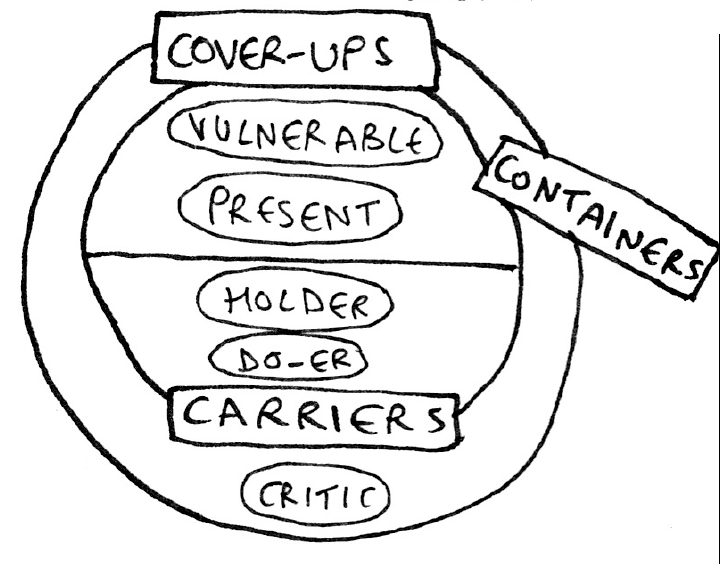
Different types of selves need different kinds of work. Meg-John Barker suggests the following:
The cover-ups: they should let go of what they have been doing for so long, which is covering up for the carriers. This would allow them to rest and let themselves be looked after. It is important that they manage to feel ‘real’, because they have always felt a bit fake, knowing that they are not the whole of who you are. It is also important to realise just how well they have done in getting you this far.
The carriers should learn to show themselves exactly as they are, without holding anything back, and to feel welcome rather than as though they are going to ‘ruin’ things. It is important that they can openly share all the painful things they keep inside, and that you accompany them through this process. Although they are often our renegade selves, it is important to recognise just how essential they are.
The containers: we often don’t realise they exist, and it is important to acknowledge their presence and fully integrate them into your team, system, family and life. That way, they can look after you, rather than being delegated to look after other people, or having you seek that care from others.
Zora: You see, Cris, you should take a break and stop covering us up. You’ve always been our protector, but you haven’t left us any space. I understand that it was you who let us escape from our parents’ house, and that saved us at the time. But you can stop doing that now.
Cris: I know, Zora, I know. But I’m still finding it hard. I’m learning to do what I love – activism – without covering you up. But sometimes I lose control… I’m really sorry, Zora.
The aim of working with one’s own system of selves is not to ‘unify’ it – to arrive at a single self – but to build a community of selves in which all selves feel heard and seen, and each self can express itself as it is. In this way, it is possible to create a team of selves that communicate well with one another and resolves internal conflicts through listening and care. In this way, too, each self can present its strengths to the outside world when appropriate, without overshadowing the other selves.
In this model of selves, there is no ‘Self’ to be discovered or liberated, nor is there a hierarchy of selves. Each self is equally important and has its role within the system. Healing the wounds of the ‘carriers’ – the vulnerable ones, and often the critics – ensuring that the ‘cover-ups’ can take a step back, rest and make space for the others, and becoming aware of the existence of the ‘containers’, is the crucial work required to achieve a harmonious system of selves.
Our system of selves
Zora: Phew. I think it’s our turn to talk about ourselves now.
Cris: I’m afraid so, Zora. Do you want to start?
Zora: No, I’d prefer you to start, Peluchita, if you don’t mind. You’re our witness, our observing self.
Peluchita: OK. So I’m going to start by introducing our system of selves. But you’ll have to help me.
I’ll start with our carriers, or, more specifically, our vulnerable selves. Here we have our peque, our little one, who probably experienced the first abandonment of all when he was 1½ years old. His sister was born, and our peque was kicked out of his parents’ bedroom. But, from that moment on, his emotional needs were no longer being met. So, our peque experienced their first trauma of abandonment at just 1½–2 years old. Now, we’re all looking after them and giving them our love, so that they never feel abandoned again.
And then, Alex, there’s you, our gender bender. We don’t really know what happened to you, but we do know that you also suffered trauma at the age of six.
Alex: Yes. I don’t have any memories of it. But I’m really scared to make movements when other people can see me. It makes me feel like I’m being watched and judged, and I freeze up. So I’d rather not do it. Especially when you have to move in a certain way. Although, I don’t like not doing it either.
Zora: Yes, Alex. I remember when, two years ago, we went to a contemporary dance class. On the one hand, you were really keen; on the other, you were really scared. Alana had a hard time calming you down before the first class. You wanted to run away, to escape. But then you really enjoyed it, didn’t you?
Alex: Yes, I did. I think I’d like to dance, play and all that sort of thing, but I’m really scared. And I don’t know how to play, for example. I’m really embarrassed, but I just don’t know how to play.
Alana: There’s something else I’d like to mention about you, Alex. When I asked you, perhaps two years ago, not to dwell on the pain and sadness of your unlived trans childhood, but to imagine what you would have liked to experience, you didn’t hesitate. You didn’t have to think twice. You took the photo from your first day at school and drew yourself over the top of the boy they forced you to be. And by doing this, you also made it possible for me, Alana, to see myself in that photo for the first time, rather than an unknown boy13. That was really lovely, Alex, and I’m so grateful to you.
Alex: Now you’re making me feel embarrassed. But, yes. I really didn’t like having to go to school. I really didn’t like having to be a boy. It never worked for me. And I think that’s why I’m so scared of having to move around in front of other people, too. They judged me and excluded me. I wasn’t a ‘boy’. And no, I never have been.
Peluchita: You were very brave, Alex. You’re a very brave and resilient person.
Zora, now let’s talk about you.
Zora: Hmmm.
Peluchita: Zora’s another one of our vulnerable ones. And we know what happened to her – or at least we’ve got a better idea.
Zora: Do you have to talk about this? You know I don’t like it.
Peluchita: Yes, I know you don’t like it. But I think we need to talk about this.
So, Zora, shall I do it, or shall you?
Zora: You start, please.
Peluchita: OK. As I’ve already said, Zora is another of our vulnerable ones. Zora is a survivor of childhood sexual abuse. She was abused by her father. But she was also threatened by her mother with being sent to a care home for children with behavioural difficulties, as she would sometimes lose her temper, especially in the face of injustice. No one ever asked what she was going through. So, on top of the trauma of the abuse, there was a deep trauma caused by neglect and a lack of emotional support. Zora always felt very alone.
But Zora is also a fighter, and she’s very resilient. And today, Zora also protects and looks after Alex and La Rigby, in particular. Furthermore, Zora remains the part of us that best connects with and expresses their anger.
Is that OK, Zora?
Zora: Yes. Thank you.
Peluchita: We’ve still got more selves. There’s also La Rigby, another of our vulnerable ones. At first we thought La Rigby was a boy. She takes her name from the character Rigby in Tom Spanbauer’s autobiographical novel Now Is the Time, as the themes of loneliness and not feeling understood or seen resonated deeply with La Rigby’s experience. However, we later realised that La Rigby is, in fact, a trans teenage girl, so now she is no longer Rigby, but La Rigby.
La Rigby never felt understood or seen, nor did she feel loved. She felt trapped in an unbearable situation. She didn’t know how to escape. To leave her parents’ house. La Rigby also suffered a great deal of bullying. She has always had suicidal thoughts, although she never attempted it. Today, La Rigby is perhaps our most vulnerable self, with depressive tendencies.
Zora: It really hurts me when La Rigby is feeling down, or when, yet again, people ignore La Rigby and refuse to see who she really is. It makes me so angry.
Peluchita: I know, Zora. When this happens, you want to protect La Rigby, and I’m grateful for that. But you often do it out of your own anger, which might not be what La Rigby needs right now.
Zora: Do you think so? I don’t know. Maybe you’re right.
Peluchita: I think you should listen more to La Rigby when she’s feeling down, and not let your anger get the better of you. We’ve had to rein you in a few times, remember?
Zora: I’m sorry.
Peluchita: Think about it, Zora.
I’ve already introduced all our carriers: our little one, Alex, Zora and La Rigby. Now I’m going to introduce you to our cover-ups. There are just two of them: Ginger and Cris.
I’ll start with Ginger. Ginger is a visionary. And, with their visions of a better world, of actions, and so on, they have the ability to inspire others and motivate them. They also inspire the rest of the community, especially Cris. I’ve almost always seen Ginger as part of the ‘Cris and Ginger’ team – that is, our activist self (Cris) working alongside our visionary, utopian self – Ginger.
Ginger: I don’t know, Peluchita, but I think I understand you. I’ve almost always kept a bit of a distance, perhaps observing, sometimes contributing an idea, a vision, my utopia. The truth is, I wasn’t really very connected to my past either before teaming up with Cris. And perhaps that’s why you came to think that I’m just a part of Cris.
Peluchita: Yes, that could be. But two years ago, we realised something else. In reality, Ginger was born as one of Zora’s fantasies.
Zora: I relied heavily on Ginger during the years of sexual abuse – not just during the abuse itself, but perhaps even more so during all that loneliness that went hand in hand with it. I had no one to talk to.
Ginger: Zora, but didn’t you realise that you created me, that – at least initially – I was a fantasy of yours so that you wouldn’t be left alone?
It’s true, I took you to another world, a nicer world, without adults. And I took you on one of the trains from my model railway, and each time I let you choose which train to take and where to go.
I know you needed that to survive. You needed to escape from this hostile, violent world, from the abuse and the loneliness14.
Peluchita: Yes, Ginger. You had your model railway, which was your whole world, and it let you create another world, dream of another world. When you had to take it apart, it was really traumatic for you. Let’s see if, at some point, when we’ve got a bit more money, we can buy you at least a little train, even if it’s not a whole model railway.
Ginger: That would be brilliant, Peluchita.
Peluchita: So, over the years, Ginger became more independent, and Cris emerged – our activist self, another of our cover-ups.
For Zora, Ginger was the escape, and later on, activism was the escape to another world. And, through activism, Cris also opened up the possibility for us to leave our parents’ house. Which probably allowed us to survive. This escape was incredibly important.
Even so, Cris continued to cover up for the rest of us. Hyper-activism had allowed us to survive and get out, but hyper-activism remained the mechanism for keeping us away from ourselves, for covering up our vulnerabilities.
Cris: I’m sorry. You’re probably right, Peluchita. But that’s all I knew how to do.
Peluchita: You don’t need to apologise, Cris. You saved us. But it took you a long time to stop covering us up, and perhaps you only did so when you couldn’t take it any more – when you broke down. And this happened twice: the first time in 2016, when we suddenly connected with our past, with some of our vulnerable selves (or, with this vulnerability, without connecting with the selves in that moment), and again at the end of 2021, which led us to finally connect, little by little, with our community of selves.
Cris: I think my tendency towards hyper-activism is also a response to never having felt loved. So, being active in activism – at least that’s how it is for me – makes people love me. I understand that’s not how it works; I understand you don’t have to earn being loved, but this wound is still there.
Peluchita: I know, Cris. And we’re here too to look after you and to remind you that you also have the right to rest. And you’ve become much calmer in recent years; you’re allowing yourself to rest more and to do nothing. Little by little, Cris. And we want you to carry on with your activism. That’s for sure.
Now, let’s move on to our containers. Here we have, above all, Alana, our queer self. Although, for Alana too, it’s been a process of moving from being a vulnerable self to a container. Perhaps they are still both things at the same time.
Cris: Peluchita, let me introduce Alana
Peluchita: OK, Cris. Go on!
Cris: Thanks. Yes, Alana was initially one of our vulnerable ones15. We connected with Alana three years ago, but in reality Alana had been trying to make themselves heard for over 25 years, though they hadn’t managed to do so until a few years ago. That’s why Alana also carries a fair amount of trauma from not being heard, and also from a trans/queer life that went unlived for many years.
Before that, we also had our ‘Andrea’ or ‘Adriana’ self, who was our container at the time. However, Adriana needed to allow themselves a break, and so Alana took on that role. Over time, Adriana faded away, and only Alana remained, who more or less took on that role, despite their vulnerability.
Zora: Yes, Cris. And they do it very well. I often feel listened to and supported by Alana. They are always there when I need them.
And then there’s you, Peluchita. In a way, you’re a source of support too, especially for Alana. You look after the one who looks after us. Although you started out as a stuffed toy, you’re now one of our selves. An observant self, a self that’s sometimes critical, but also capable of encouraging us – especially Alana. I know Alana needs you.
Cris: Yes, Zora, Peluchita is also one of our sources of support.
Perhaps we can picture our system of selves like this. At the bottom centre are our vulnerable ones: Peque, Alex, you, Zora, and La Rigby. Although, Zora, you also extend slightly outwards from the centre into a circle around the containers. At the top of the centre we have our cover-ups: Ginger and me. And, in a circle around them, we have Alana (and, partly, you, Zora), and in another circle around that, Peluchita. I don’t know. That’s how I picture it. Zora, do you want to draw it?
Zora: I don’t know. If I feel up to it, I’ll post the drawing here. But yes, I also picture our system of selves more or less like that.
Peluchita: I think this description works for me too.
Zora: Here’s my drawing.
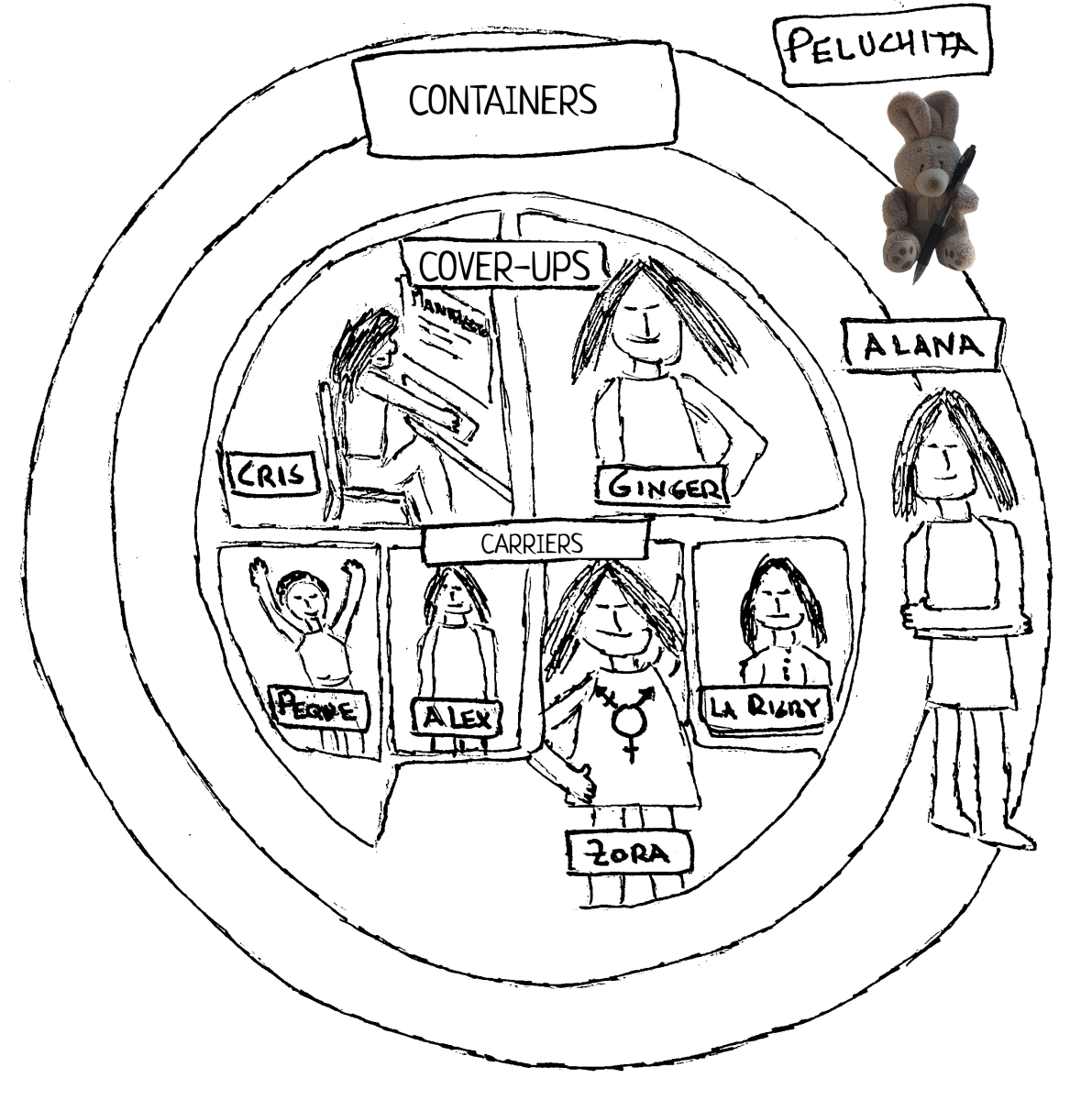
Zora’s drawing of our internal community
Our inner community is not static. It is constantly evolving. Since our last zine about our inner community16, three years ago, a few things have changed. Some selves have disappeared, whilst others have transformed; for example, Rigby has become La Rigby.
So, Zora’s drawing depicts our community of selves as it stands today. We do not know how our community of selves will evolve in the future.
Our selves and their ways of relating
As each self has its own personality, its own traumas and its own experiences, it is perhaps not surprising that the selves also have different ways of relating. Not only to one another, but they also have different ways of relating to other people. In other words, when we relate as Alana – the community of selves – to other people, various forms of relating come into play. Generally speaking, at least after a while, there isn’t just one relationship, but rather several relationships with the other person, and sometimes with the other person’s different selves. For example, Alex might have a closer relationship with the other person’s boy, girl or non-binary child, if that child becomes outwardly visible, whilst Cris might have a closer relationship with the other person’s more activist side. Even if the other person does not identify as plural, our selves connect with different aspects of the other person, and in different ways.
For example, our Zora generally takes a long time to form a bond with another person or another aspect of someone else. At first, she keeps her distance, observing what happens and how the relationship with that person develops through our other selves, but she doesn’t trust them, so she doesn’t want to form a bond. However, when she does eventually form a bond, it is a deep one. Zora cannot cope with superficial bonds. She also has a certain intuition about whether or not a bond is safe. This probably stems from her experience. Also, based on her experience, what Zora seeks in a bond is to feel cared for, and when this happens, she is also able to care for the other person, or the aspect of the other person with whom she has formed a bond.
On the other hand, Alex seeks to form bonds, and builds them much more quickly if the other person has a self or a part that allows Alex to form a bond. These bonds are perhaps more childlike, arising from play, although Alex finds it very difficult to play – they don't know how to play.
And Rigby, generally speaking, does not form bonds. She is still very withdrawn, and perhaps responds when another person – or another person’s self – wants to bond with her. But she does not take the initiative herself.
In the zine Triangles and Circles of Selves, Meg-John Barker refers to a model by Emmi Bevensee on the complexity of relationships.
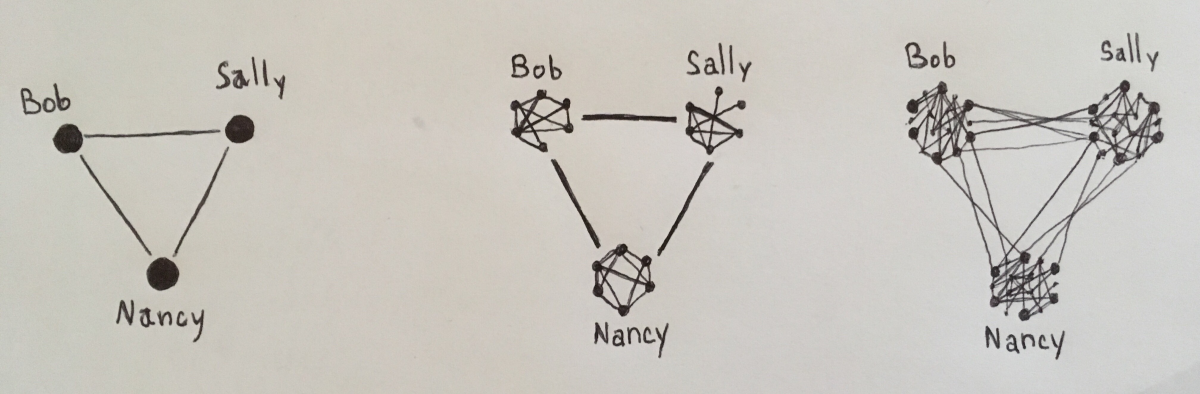
Image: Selves in networks. By Emmi Bevensee17
According to Emmi Bevensee, in our society networks are generally understood as connections between unique selves. In the second image, although each self is more complex and multifaceted, the network relationships remain unique. In the third image, we see how the different selves within each person relate to the selves of other people, thus forming a much more complex network.
Meg-John Barker (or, rather, Fox from the team MJ) says that this image “seems very useful to us for illustrating how people tend to assume that they are singular selves that relate to one another, or perhaps that each person is a complex system but that, at the very least, each system has only one relationship with another. In reality, it is probably more realistic to view ourselves as systems in which each of our selves is connected to every self in the other system.”18
We believe that, in our case, it depends very much on the other person whether a network of relationships like the one in the third image emerges, or rather a distinct relationship between each or some of our selves and a self that presents itself as the unique self of another person. However, even in this case, it is more likely that our selves form bonds with different aspects of the other person – for example, Cris with the activist side, and Zora perhaps more with the caring side. Perhaps, in a way, our selves seek out the other person’s selves, even though that person themselves is not aware of them.
In our experience, if a bond involving Zora is missing from our bonds with another person, the rest of the relationships have their limitations. Without Zora, something very important is missing from a system of relationships.
How do selves emerge?
The selves are there, although many people are probably not in touch with their selves. But how do the different selves emerge? Have they always been there?
Donald Torres says: “Subpersonalities do not arise in a vacuum, but are shaped by a complex interplay of factors throughout an individual’s life. Childhood experiences, such as relationships with carers, significant events and cultural influences, play a crucial role in the development of subpersonalities. For example, a child who has suffered neglect or criticism may develop a subpersonality that seeks approval or validation from others.”19
Some psychologists say that the first selves emerge whilst we are still in the womb, through our interactions with the outside world. I don’t know, and I don’t want to dwell on this. It’s not a subject that particularly interests me.
According to John Rowan, some subpersonalities (or selves) emerge from the roles we take on in our lives: “There are certain roles that are known to give rise to the creation of subpersonalities: the mother, the teacher and the social worker are some examples.”20
Beyond these roles, internal conflicts can give rise to new subpersonalities, or even fictional characters, such as those from TV series or films. According to Rowan, furthermore, the personal unconscious, the cultural unconscious and the collective unconscious can all contribute to the formation of subpersonalities (selves).
According to John Rowan’s theory, selves are the result of splits. We begin in a state of ‘I am fine, the world is fine’, possibly, according to Rowan, in the womb of the expectant parent. An event challenges this state of ‘I am fine’ and causes a split. A self emerges that attempts to adapt to what has happened in order to return to the state of ‘I am fine, the world is fine’, although this may be impossible. The original self becomes trapped in this moment; we repress it, and it becomes one of our carriers and vulnerable selves.
Zora: Perhaps our peque is the result of a split like that – our sister was born when we were 1½ years old.
Peluchita: I don’t know, Zora. I think our peque is actually the part of us that used to let us feel this ‘I’m fine, the world’s fine’, and was starting to feel abandoned. That’s where their abandonment trauma comes from. Perhaps Alex, you’re the result of a split to adapt to this situation – with little success, mind you. Or even you, Zora. Perhaps both of you.
Many of these selves are reactions to events that are more or less traumatic. Perhaps, from an adult’s perspective, they do not seem traumatic, but from a child’s perspective – especially that of a very young child – they can be deeply traumatic. And, in our case, as a girl was born – perhaps Zora, but also Alex, our little gender-bender – these are reactions to this traumatic event of abandonment, as now a girl was receiving all the attention. Being a boy, perhaps, was no longer of any use.
We’re not entirely sure when or how La Rigby emerged (initially as Rigby); perhaps it was after our mother threatened to send us to a care home for children with behavioural problems for expressing our anger, which left Zora traumatised. In fact, Zora would freeze at this moment. She is this eleven-year-old girl facing the threat of abandonment, whilst also carrying the trauma of sexual abuse. Rigby (or La Rigby), on the other hand, bottoms up all her emotions. Above all, she is unable to express her anger – her anger turns inwards. Not showing anger was her coping mechanism, perhaps so that she could feel okay, feel accepted by the world, or by her parents. But the truth is that she soon began to feel trapped in an unbearable situation.
Perhaps this is why Cris came into being. As home was never a safe place where any of our selves could feel loved, whilst on a apprenticeship, already as a teenager, I began to get involved in the trade union’s youth wing. And suddenly, through that activism, a self emerged who felt loved and valued for their activism – Cris. From then on, Cris took on an increasingly important role, covering up the rest of our selves. They had found a way to survive. They gave up seeking our parents’ approval, instead seeking approval, validation and a sense of being loved elsewhere – in activism.
Although on the outside Cris might have seemed very confident, behind this mask of confidence lay a deep insecurity and rather low self-esteem.
Another exception, perhaps, is Ginger. Ginger emerged as a fantasy of Zora’s; they only existed in her imagination, and later teamed up with Cris – the Cris and Ginger team, which shaped our activist life and our lives in general for decades.
The selves and working through trauma
Every person – or, every system of selves, or subpersonalities – is different, and here I can only speak from our own experience. What has worked and continues to work for us does not necessarily have to work for your system of selves.
As we have almost no conscious memories of our childhood – absolutely none until the age of ten or eleven, and very few until the age of twenty – working with our different selves and their emotions is often the only way to come to terms with our traumas. For example, through our work with Zora, we were able to accept the sexual abuse we suffered in our childhood as a fact, even though we have no clear memories of it – only blurred images. This work also helped Zora begin to heal her wounds, both from the abuse and from the neglect, and it was crucial for Zora to find a way to express her anger, which she began to do through drawings. Although Zora remains vulnerable, she has at the same time become a fighter; she helps us set boundaries (it is Zora who would never accept a cis male psychologist or doctor, and she makes this very clear).
Now, when something triggers our PTSD, the first thing we try to do is identify which of our selves has been triggered by the trauma. This helps us to pinpoint the trauma in time, and also to identify the type of trauma. But, above all, it allows us to support this triggered self through its trauma, to offer it safety and love, and to explore what this self needs at that moment. It is often a team effort; in other words, several selves may try to support the traumatised self.
Healing trauma – or, perhaps, better still, learning to live with trauma, not just survive it – means tending to the traumatic wounds of our selves, so that they do not remain trapped in patterns of response to trauma; patterns which, at the time, enabled us to survive, but which, perhaps, today, in a different context, are no longer the most helpful responses. This often begins by making them feel loved, helping them understand that they are no longer alone, and that they are now safe, that nobody is going to hurt them.
Although the latter is not necessarily true, as in relationships – with a boss, with friends, or, in general, with other people – the other person may hurt you, often unintentionally, by doing something that touches on your traumatic wound. When this happens, this self's trauma response pattern is triggered, which is not necessarily the most helpful response. So, the work involves, after identifying the self that is affected and trapped in its trauma, helping this self to realise that it is not alone, that the situation is different, that it can feel safe, and to seek a different, healthier response to the situation. Often this is only possible after the automatic trauma response – which may have caused harm to the other person or to the relationship – and it may be necessary to make amends. Only gradually is it possible to deactivate the trauma response pattern, which was a survival mechanism.
In any case, the key, for us, lies in supporting our different selves, so that each self can feel loved, safe and valued, and is able to show itself as it is – with all its vulnerability, but also with all its capabilities. It is a process that probably never ends.
As a way of closing
Zora: What else do we want to say?
Peluchita: Do you think we need to say anything else?
Zora: I don’t know. Perhaps we should emphasise that we’re not going to disappear? That it makes no sense to seek a single self, that ‘healing our trauma’ cannot mean making us disappear?
Cris: I think what Zora’s saying is important. Trying to construct – artificially – a single self would mean, once again, repressing ourselves, stifling ourselves, and that would be unhealthy. It’s much healthier that we can learn to work well as a team.
Peluchita: Just as we’ve tried to do in writing this article?
Cris: Yes. Zora, I hope I haven’t covered you up?
Zora: No, Cris. Not this time. Thanks for respecting me.
John Rowan says in the book Personification: Using the Dialogical Self in Psychotherapy and Counselling: “People who have reduced the self to something singular and simple still fail to understand it and find it difficult to see how the self can be multiple. They seem to think that having a single self is normal. But this means they have to ignore the equally obvious truth that people are multiple. Who has not experienced feeling divided? Who has not experienced having to endure conflicting voices within themselves? Perhaps it is the single self that needs to be justified, in the face of the evident multiplicity we find everywhere?”21
Our selves are present in every aspect of our life (or lives?). As Donald Torres puts it, “Subpersonalities do not exist in isolation, but are closely interwoven into the fabric of our lives and influence the way we function in various contexts and relationships.”22
With this in mind, we invite you to discover your inner world, your community of selves.
About our author selves:
Cris is our activist self. They often work alongside Ginger, our utopian and visionary self. If you know us through our activism, you’re likely to be most familiar with Cris and Ginger from our community.
Peluchita isn’t just a stuffy toy; she’s also our inner observer – and sometimes a very critical one at that. Her way of offering criticism is to ask us questions that make us think and look for alternatives. What’s more, she also praises us when we do things well. And she helps us to reflect.
Zora is one of our internal girls. She was the first self we connected with. Zora is a survivor of sexual abuse and emotional neglect, but today she has become a transfeminist activist, and she is also the self within us who connects most deeply with anger.
Notes
1James Fadiman y Jordan Gruber: Your Symphony of Selves. Discover and Understand more of Who You Are. Park Street Press, Vermont, 2020
2John Rowan: The Normal Development of Subpersonalities. En: John Rowan y Mick Cooper (ed.): The Plural Self. Multiplicity in Everyday Life. Sage Publications, London/Thousand Oaks/New Delhi, 1999
3Meg-John Barker (2020): Plural Selves, Queer and Comics. Journal of Graphic Novels and Comics, DOI: 10.1080/21504857.2020.1774403
4Meg-John Barker: Plurality 1, free book available for download at https://www.rewriting-the-rules.com/wp-content/uploads/2025/09/Plurality-1.pdf
5David Lester: On Multiple Selves. Routledge, 2017, Oxon and Nueva York
7Richard C. Schwartz: Introducción al modelo de Los Sistemas de la Familia Interna. Editorial Elefthería, Barcelona, 2015
8Alana Queer, Abolish the family. A survivor’s perspective, translation from the Spanish original published in El Salto Diario, 15 Mai 2025, https://alanaqueer.es/content/abolish-family-survivors-perspective
9Richard C. Schwartz: Introducción al modelo de Los Sistemas de la Familia Interna. Editorial Elefthería, Barcelona, 2015
10The fanzines on plural selves can be download from the blog of Meg-John Barker: https://www.rewriting-the-rules.com/zines.
11Meg-John Barker: Plural Selves 2. Befriending your Selves, https://www.rewriting-the-rules.com/zines/#1666773481636-89244c23-4a43
12Meg-John Barker: Plural Selves 2. Befriending your Selves, https://www.rewriting-the-rules.com/zines/#1666773481636-89244c23-4a43
13Alana Speck: Letter from Alana, my adult queer self, to Alex, my gender bender kid self, in: Lucas R. Platero, José Antonio Langarita, Irene Blanco Fuente (ed.): Me insultan y yo les tiro un beso. Infancias y adolescencias LGTBIQA+, Bellaterra Edicions, 2025, https://alanaqueer.es/content/letter-alana-my-adult-queer-self-alex-my-gender-bender-kid-self
14Zora, Ginger and Alana: Zora and Ginger, https://alanaqueer.es/content/zora-and-ginger, 28 March 2024
15Alana Queer: Let me introduce myself: I am Andrea's queer self between 25 and 35 years old, https://alanaqueer.es/content/let-me-introduce-myself-i-am-andreas-queer-self-between-25-and-35-years-old, 18 July 2023
16Equipo Alana Queer: Llegar a Ser Yo Misme. Un zine sobre como hemos llegado a nuestra identidad de género genderqueer (no-binaria), 27 de julio de 2023, https://alanaqueer.es/es/contenido/llegar-ser-yo-misme
17Emmi Bevensee: Widening the Bridges: Beyond Consent and Autonomy, Center for a Stateless Society, 17 de marzo de 2018, https://c4ss.org/content/50557
18Meg-John Barker: Triangles and Cirlces of Selves, https://www.rewriting-the-rules.com/zines/#1699530192652-bd07157b-78f8
19Donald Torres: Conoce a tu tripulación interior: Subpersonalidades, 11 de febrero de 2024, translation by Alana Queer, https://alanaqueer.es/es/contenido/conoce-tu-tripulacion-interior-subpersonalidades (the English original is no longer available)
20John Rowan: The Normal Development of Subpersonalities. En: John Rowan y Mick Cooper (ed.): The Plural Self. Multiplicity in Everyday Life. Sage Publications, London/Thousand Oaks/New Delhi, 1999
21John Rowan: Personification. Using the Dialogical Self in Psychotherapy and Counselling, Routledge, 2010
22Donald Torres: Conoce a tu tripulación interior: Subpersonalidades, 11 February 2024, translation by Alana Queer, https://alanaqueer.es/es/contenido/conoce-tu-tripulacion-interior-subpersonalidades (English original no longer available)
